

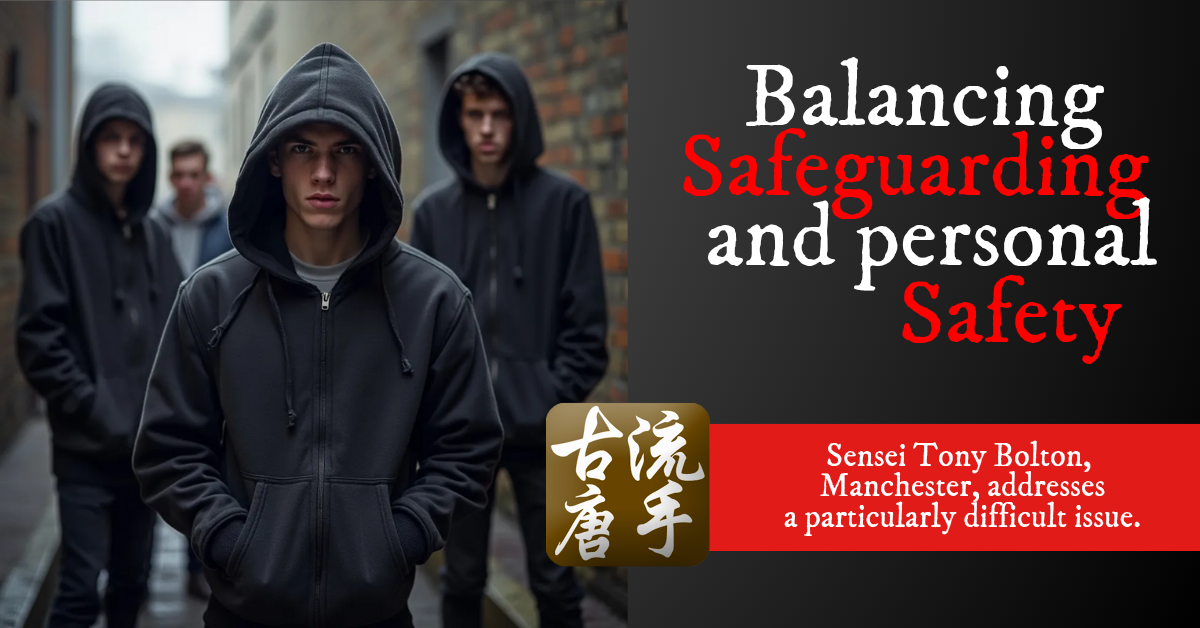
Sensei Tony Bolton, Manchester, addresses a particularly difficult issue
In recent years, UK police statistics have highlighted a concerning trend: as children transition from primary to secondary school, their risk of becoming either victims or perpetrators of antisocial behavior and criminal activities increases dramatically. While social media and rapid news circulation may amplify these concerns beyond their actual scope, the challenge of managing conflicts involving young people remains very real.
The Modern Context
Balancing the safeguarding of young people while ensuring personal safety presents a unique challenge, particularly when dealing with an aggressor under 18. The ubiquity of social media and viral videos has made this issue increasingly complex. These clips often lack crucial context, as viewers typically focus on the dramatic elements rather than the full story. Public perception is often shaped by optics—how a situation appears rather than what actually occurred—making it essential to handle these encounters with strategy and composure.
Understanding the Cycle of Conflict
A recurring pattern emerges in many conflicts involving young aggressors:
- The aggressor attempts to provoke through threats and intimidation
- The target becomes emotionally reactive
- The aggressor escalates upon seeing this reaction
- The target feels cornered into physical response
- The aggressor immediately switches to playing victim
This cycle is particularly dangerous in today's environment, where any physical confrontation involving a minor can lead to severe legal and social consequences for the adult, regardless of the circumstances leading to the incident.
Martial Arts Principles for Modern Conflict Resolution
Traditional martial arts, particularly karate, offer valuable principles for handling these situations:
- No First Attack (空手に先手なし): Emphasizing restraint and avoiding emotional reactions
- Beyond the Dojo (道場のみの空手と思うな): Applying conflict management skills in real-world situations
- Focus on Not Losing (勝つ考えは持つな): Prioritizing safety and de-escalation over "winning"
- Self-Awareness First (自己の研鑽に努むること): Understanding your own triggers to prevent manipulation
Practical Application: Verbal Jiu-Jitsu
The concept of 言葉の柔術 (Verbal Jiu-Jitsu) provides effective tools for de-escalation:
- Maintain calm composure
- Redirect aggression through non-threatening communication
- Offer controlled choices for peaceful resolution
- Stay aware of surroundings and potential exits
Conclusion
In an era where young offender incidents are increasingly visible through social media, the principles of martial arts become even more relevant. The goal isn't just about physical self-defense—it's about maintaining safety while respecting legal and ethical obligations to protect young people, even when they may be the aggressors.
As Bruce Lee famously demonstrated, "the art of fighting without fighting" often provides the best solution. By applying these principles thoughtfully, we can navigate these challenging situations while protecting both ourselves and those involved, regardless of their role in the conflict.
This version maintains the core content while incorporating the specific concerns about young offenders in the UK context and acknowledges the role of social media in shaping public perception of these issues.
Recent Posts
Combat Has Structure — Chaos Is Only the SurfaceCombat often looks chaotic. Especially in unarmed fighting, many things happen at once: movement, striking, pressure, balance, clinch, interruption, disengagement, re-entry. Because of this density, fighting is often experienced as unpredictable. But experienced practitioners frequently notice something else. Beneath the apparent chaos, recognizable structures begin to appear. Not fixed techniques. Not scripted sequences. But recurring […]
Keeping Martial Arts Alive Without Chasing Every TrendKeep what survives contact. This article shows how constraints, cycles, and partner pressure turn values into behaviour — and training into something that lasts. Sandro Sandten teaches partner-contact–oriented Karate with a pedagogical and sustainable design focus. His work centres on training systems that remain functional under real-life variability — honest partner interaction, clear constraints, and […]