

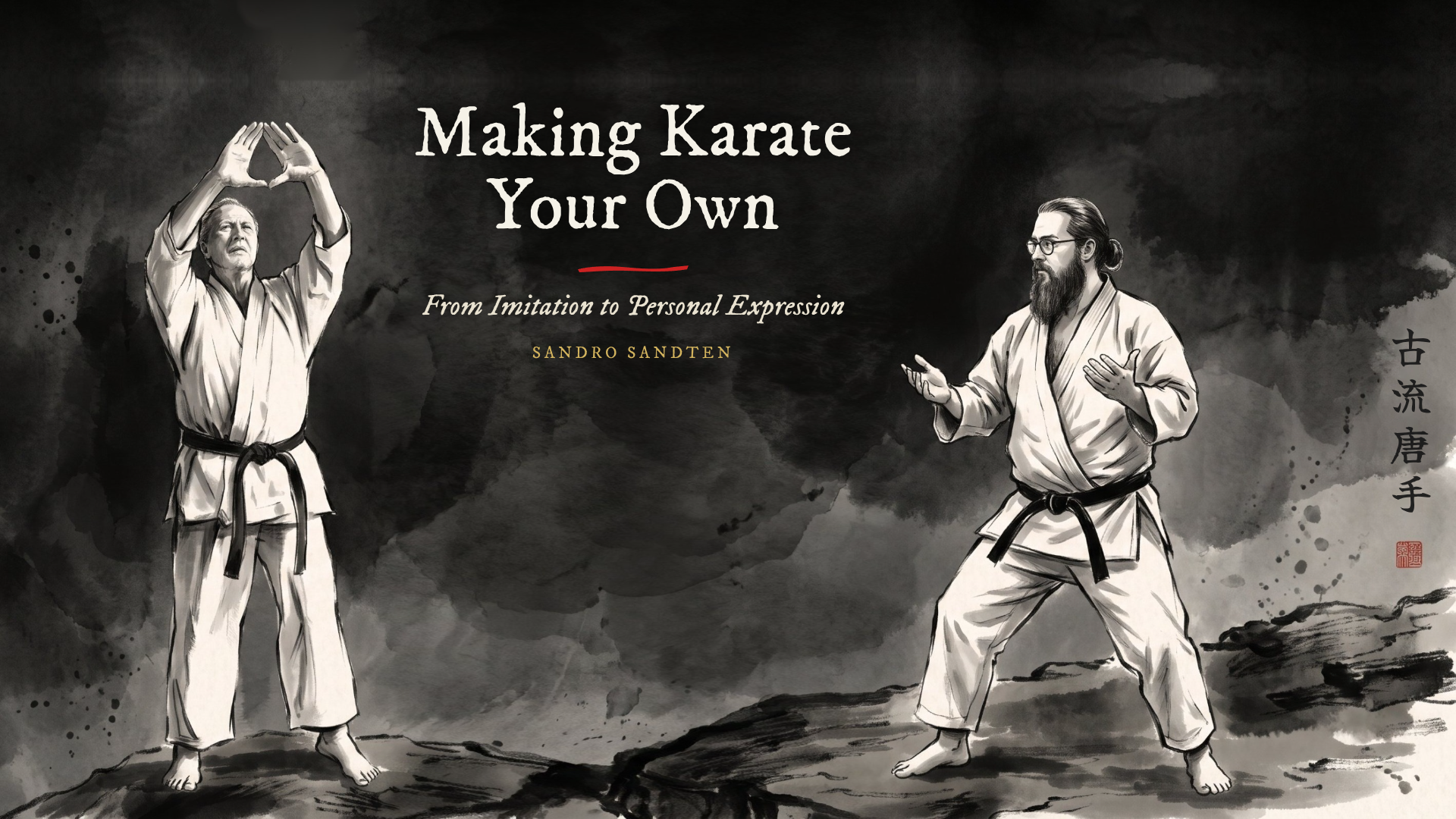
Making Karate Your Own — From Imitation to Personal Expression
What must we do as learners to make our Karate truly our own? by Sandro Sandten
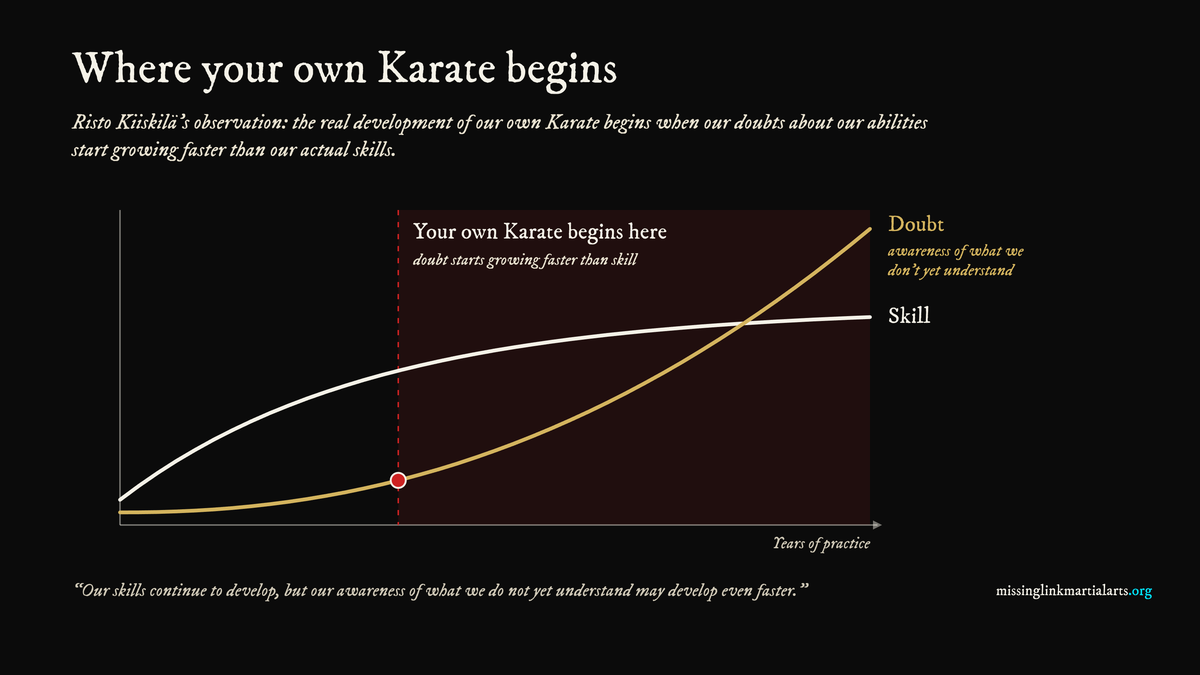
My Sensei, Risto Kiiskilä, often made a point that has stayed with me: the real development of our own Karate begins when our doubts about our abilities start growing faster than our actual skills.
At first, this may sound like a rather discouraging way of looking at progress. We normally expect increasing ability to bring increasing confidence. But something changes as our experience grows.
We begin to notice things we did not recognise before. Movements that once seemed straightforward become more complex. We discover limitations in techniques we thought we understood and realise how much we still have to learn.
Our skills continue to develop, but our awareness of what we do not yet understand may develop even faster.
This is not about losing confidence. It is about becoming more honest about our abilities and their limitations. Perhaps this is where our own Karate really begins: not when we know enough to stop questioning, but when we understand enough to realise why questioning matters.
From Imitation to Understanding
When we start practising Karate, we naturally imitate what we see. We observe our teachers, reproduce their movements and follow the methods they introduce to us.
This is necessary. Imitation provides a starting point. It allows us to acquire movement patterns, develop coordination and become familiar with the techniques and principles of our approach to Karate.
But imitation is not the same as understanding.
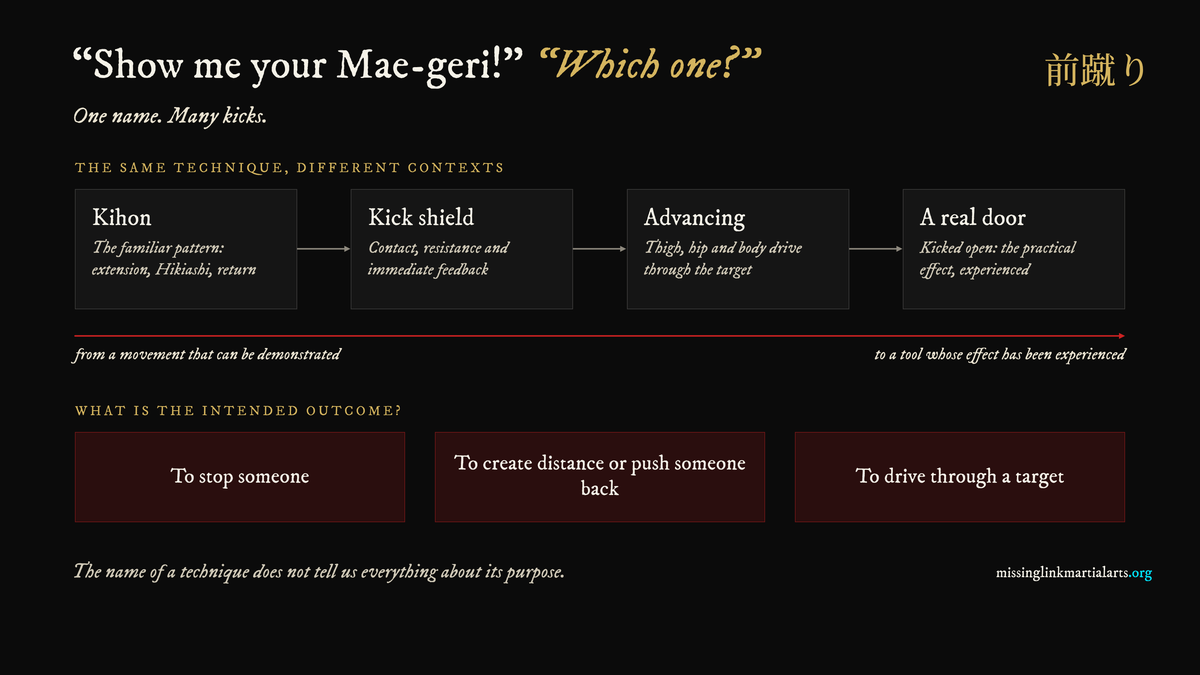
Consider a familiar technique such as Mae-geri, the front kick. A practitioner may have practised it for years in Kihon, refining its familiar movement pattern, including the extension of the leg, Hikiashi and the return to the starting position.
But what happens when we approach the same technique from a different perspective? Working against a kick shield adds contact, resistance and immediate feedback. Details that previously seemed unimportant can suddenly become apparent. The relationship between the body, the target and the intended impact becomes more significant.
A stationary Mae-geri and one performed while advancing are also different movement tasks. When the intention is to move forward through the target, the thigh, hip and body need to support that direction. The forward movement can continue beyond the moment of contact rather than simply returning the foot to its starting position.
Having actually kicked open a door adds yet another kind of experience. The Mae-geri is no longer just a movement that can be demonstrated. It has become a tool whose practical effect has been experienced.
Risto also had a habit of asking students to demonstrate a particular technique: "Show me your Mae-geri!" or "Show me your Gyaku-zuki!"
A more experienced student might eventually respond:
"Which one?"
Not as an attempt to be clever, but because the name of a technique does not tell us everything about its purpose.
Which Mae-geri are we talking about? One intended to stop someone? One used to create distance or push someone back? One intended to drive through a target? What is the intended outcome?
The same applies to Gyaku-zuki. The technique may have different purposes, and its execution needs to reflect what we are trying to achieve.
Kata offers similar possibilities. Performing a complete sequence is one aspect of its practice. Exploring individual movements, possible applications and their behaviour against a partner or a target can reveal more.
In my experience, a technique that has been practised for years can change considerably after only a few weeks of exploring it in a different context. More importantly, our understanding of the movement can change with it.
A movement may change not only in how we perform it, but also in what we understand it to be.
This is one of the ways we move beyond imitation. We begin to understand a movement, its purpose and its possibilities well enough to make informed decisions about how we use it. Heero Miketta explores a related question in Practical Skill Beyond the Tickbox. The distinction between reproducing techniques and developing practical skill provides a useful starting point. The next step is taking responsibility for what we understand and how we express it.
Making Karate Your Own – Not Making Your Own Karate
There is an important distinction between making Karate your own and simply making your own version of Karate.
Making Karate your own means developing a personal understanding of what you have been taught. It means recognising the principles behind the movements, understanding their purpose and gradually becoming able to apply them through your own expression.
Making your own Karate can mean something quite different. It can become an exercise in selecting only the parts we like, avoiding what we find difficult or changing things without fully understanding why they were developed in the first place.
Personal preference is not the same as understanding.
Before changing something, we should make an effort to understand its purpose. What is it intended to achieve? Under which conditions does it work? What might be lost if we change it?
Tradition does not mean that everything must remain untouched. Practices and interpretations can develop. But meaningful development requires more than the freedom to change things. It requires the knowledge and experience to make sound decisions.
The goal is neither to reproduce everything exactly as it was taught nor to create something entirely different simply to make it our own.
It is to understand what we have received well enough to make it part of our own expression.
From Rist-do to Your Own Expression
Risto Kiiskilä made this idea particularly tangible for me.
He used to say that he did not practise Shotokan, but "Rist-do". His Karate had been shaped by the people he learned from, the experiences he accumulated and the understanding he developed over time.
He also came up with "Sandro-Kan" for my own Karate – a playful combination of Sandro, Shotokan and Sandokan, the adventure hero known as the Tiger of Meerbusch.
It was never meant to describe a new style. It was a reminder that I should not simply reproduce his Karate or Shotokan. I should develop my own expression of what I had learned.
The same applies to any other practitioner. Someone who learns from Risto, from me or from the same group of teachers does not have to reproduce one of our personal approaches. Their physical attributes, experiences, thoughts, interests and understanding will shape their own way of practising.
A personal expression of Karate is not created by deliberately being different. It develops when we understand what we are doing well enough to make informed decisions about how we do it.
Being able to reproduce another person's Karate is an important part of learning. But remaining a reproduction is not the same as developing our own expression.
Your Karate Is Personal, but Not a Solo Project
Taking responsibility for our Karate does not mean having to work everything out on our own. A good teacher, a meaningful training structure, a shared tradition and a group of committed training partners can make an enormous difference.
A structured, principle-led approach to teaching provides direction and helps us recognise relationships between techniques. It offers a coherent framework for development rather than leaving us to collect unrelated exercises and ideas.
A good teacher is particularly important. Their experience can challenge our assumptions, offer different perspectives and help us recognise things we might otherwise overlook. But they cannot make every decision for us.
The wider community matters, too. A shared style or tradition connects us with a body of knowledge and with people who have explored similar questions before.
Training partners and peers offer something that individual reflection alone cannot provide. They challenge us, provide feedback and reveal habits we may not recognise in ourselves.
These structures and relationships should support our development, not replace our own thinking.
We need both: the guidance and experience of others, and the willingness to take responsibility for our own learning.
What Matters to You?
In the end, everyone has to decide what they want from Karate.
For one person, it may be practical application. For another, competition, personal challenge, physical development, health, cultural interest, teaching or simply the enjoyment of practising with others.
There is no reason why every practitioner should pursue exactly the same goals. What matters is that we understand what is important to us and take responsibility for pursuing it.
Does our training support the goals we actually have? Are we following a path because it continues to make sense to us, or simply because it is familiar? Are we still open to learning, or have we become more interested in confirming what we already believe?
Karate can also reveal aspects of our character. It can bring our habits, reactions and attitudes to the surface. But it does not automatically make us more disciplined, humble or considerate. We have to decide what we do with that awareness. Other activities can offer similar opportunities for personal development.
Making Karate Your Own
Your Karate does not become your own when you stop learning from others.
It becomes your own when you take responsibility for what you learn, how you understand it and how you develop it.
The teachers who influenced you, the traditions you inherited, the people you train with and the experiences you accumulated remain part of your journey. They provide knowledge, structure, challenge and support.
But they cannot do your Karate for you. That part belongs to you.
Your own Karate does not come from knowing as many techniques as possible. It develops as you increasingly understand what you are doing, why you are doing it and what possibilities you can develop from that understanding.
Your Karate is yours to develop, but you do not have to develop it alone.
About the Author
Sandro Sandten is Chief Instructor with Missing Link Martial Arts in Germany. He teaches partner-oriented Karate in Meerbusch, near Düsseldorf, with a focus on practical skill, sustainable training and the principles behind movement and technique.
Find out more about his Karate training at Karate Meerbusch.
Recent Posts
Combat Has Structure — Chaos Is Only the Surface
Combat often looks chaotic. Especially in unarmed fighting, many things happen at once: movement, striking, pressure, balance, clinch, interruption, disengagement, re-entry.
Keeping Martial Arts Alive Without Chasing Every Trend
Keep what survives contact. This article shows how constraints, cycles, and partner pressure turn values into behaviour — and training into something that lasts.