
Violence as a System
Heero Miketta on why violence never comes out of the blue, and where prevention really starts.
Most people define violence by the fist. So does most criminal law. Violence begins when someone hits, kicks, stabs or shoots. Everything else is something else.
That definition is tidy. Sadly, it doesn't work. It fails in both directions.
It sees too little. If only the physical counts, everything that leads up to the punch disappears from view. Threats, humiliation, bullying, coercive control and emotional pressure get a different label (in Britain usually "abuse") and end up in a different drawer. That cuts the one connection prevention needs most. Physical violence is almost never the start of a story. It is the last step on a long road, and that road is paved with non-physical violence.
Even the extremes prove it. A rape in which the victim freezes involves no physical struggle, and it is an act of total violence. Freezing is an involuntary survival reflex, not consent: in a Swedish study of women seen at an emergency clinic after a sexual assault, seven in ten reported significant freezing during the attack.
A child who grows up under relentless humiliation and arbitrary punishment, without ever being hit, is still growing up in violence. And the odds rise that violence follows later, outward against others or inward against the self.
Defined by the fist, violence looks like weather. It strikes out of a clear sky, senseless, the work of a few bad people. That picture is wrong, and it makes prevention impossible. You can't prevent what you only notice at its endpoint.
It sees too much. Not everything physical is violence. A rugby tackle, a boxing bout, hard sparring in the dojo, two friends play-fighting, a coach catching a gymnast, a carer restraining a person with dementia, a father pulling his child out of traffic: all of them meet the mechanical criteria of physical force. None of them is violence in any sense worth preventing. They happen inside consent, care and clear boundaries.
The same grip that saves a child at the kerb is an assault in an argument at home. Context and consent decide. Mechanics don't.
Three forms of violence
To understand how violence develops, we have to look at the whole system rather than its physical endpoint. In German violence-prevention work, we have distinguished three forms for decades:
- Physical violence: direct bodily force. The most visible form, and the only one that law and custom reliably sanction.
- Psychological violence: bullying, teasing, threats, humiliation, controlling behaviour, persistent disrespect.
- Structural violence: rules, norms and systems that force, restrict or grind people down. The fine, the failing grade, the arrest, the institution that makes frightened people wait until their fear turns into anger.
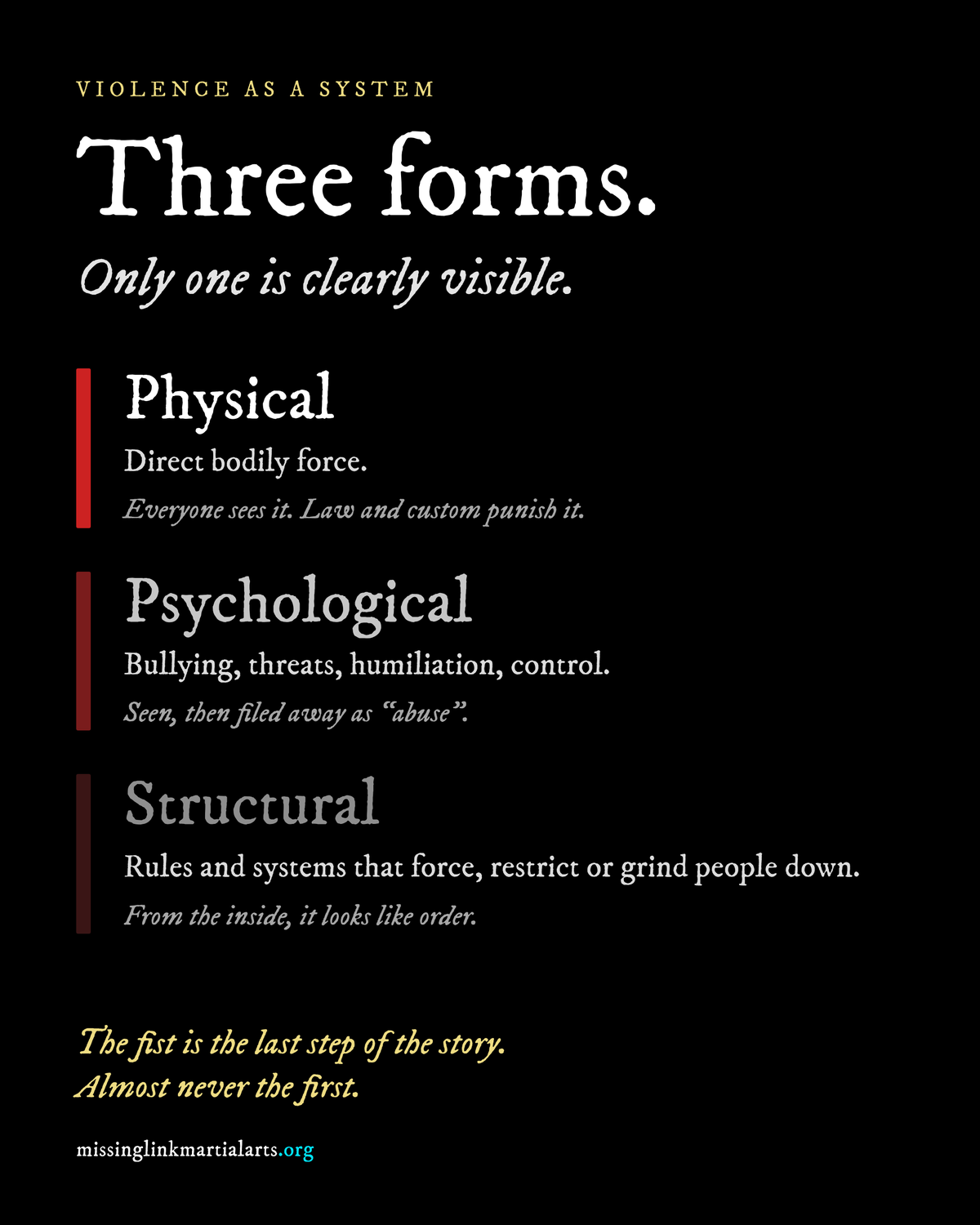
Structural violence is the hardest to see, because from the inside it looks like order: "That's just how it is." The peace researcher Johan Galtung gave it its name in 1969. Sometimes it is legitimate. It is always felt as force by the person on the receiving end. Ask children what violence is and they name the alarm clock, homework and senseless rules long before they name fists.
History shows where violent rules can lead. The regulation that forced Jewish citizens in Germany to wear a yellow star was not physical violence. It built the road straight to it.
The everyday version is quieter. An underfunded hospital, a jammed transport system, a school expected to absorb every unsolved problem of its neighbourhood: systems like these manufacture anger. And the anger lands on the nearest human being. The receptionist, the nurse, the teacher, the driver.
The anger is real. The address on it is wrong.
What happened to you?
Even three forms don't solve our practical problem in a training hall or a classroom. What one person shrugs off as a harmless punch in the stomach among friends can leave another shaken. A single snide remark can cause lasting havoc. Bodies usually heal quickly. Injuries of the soul heal far more slowly, and often leave scars for life.
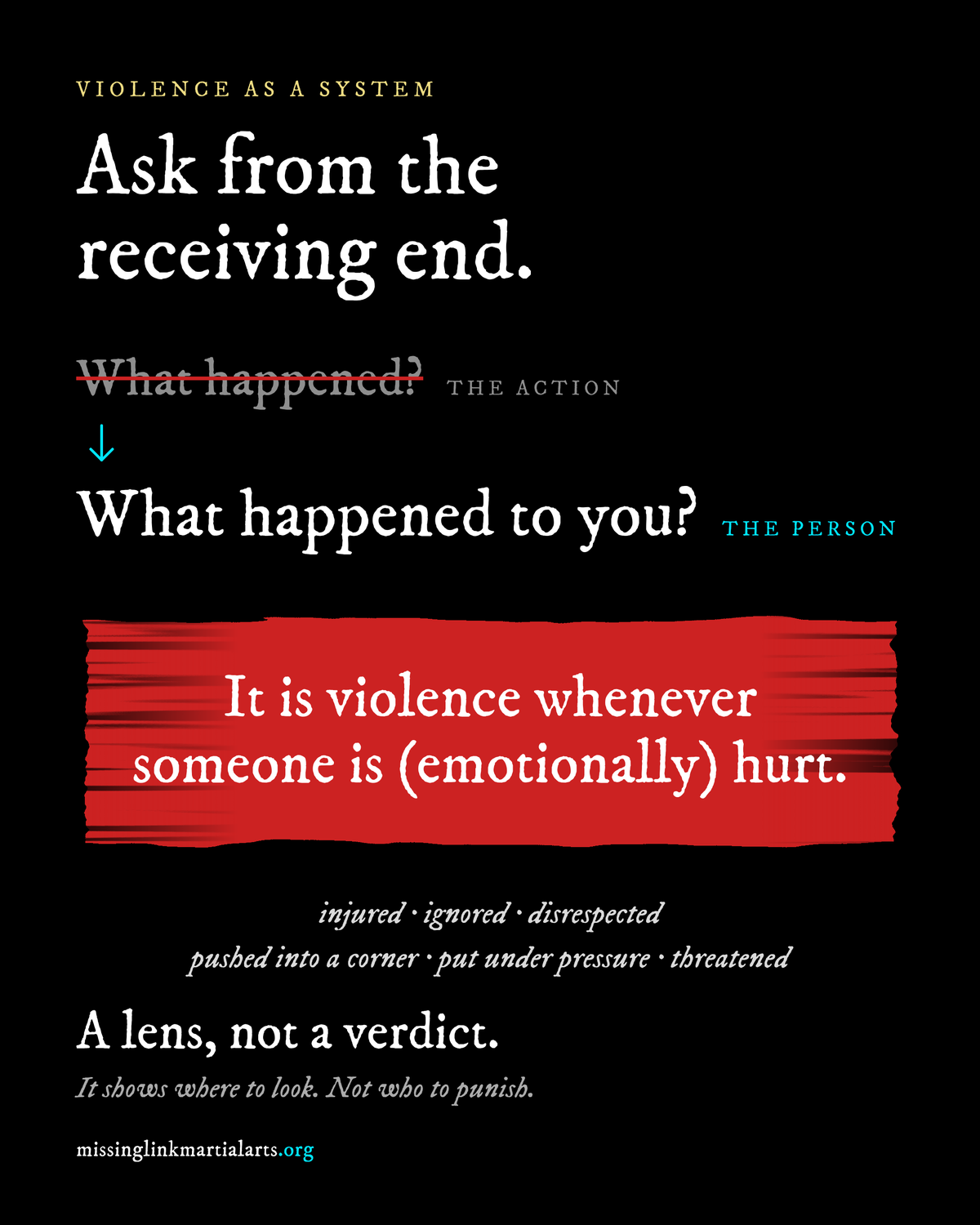
So we stop asking the operational question, "What action happened?", and ask the one from the receiving end: "What happened to you?" Trauma-informed care made the same switch years ago. It gives us a definition people can actually work with:
It is violence whenever someone is (emotionally) hurt.
Whenever someone is injured, ignored, disrespected, pushed into a corner, put under pressure, or threatened by physical or psychological superiority. Seen through this lens, the structure of violence and conflict becomes clear, and so does how one leads to the other.
This isn't sentimentality. Brain imaging shows that rejection activates some of the same regions as the distress of physical pain; how far the overlap goes is still debated. And in experiments, people relive old humiliations more intensely than old injuries. Ask anyone which hurts more today: the broken wrist from school, or the teacher who mocked them in front of the class.
A lens, not a verdict
This definition is deliberately simple. But it only works whole. Half of it is dangerous.
Responsibility for what we do to others. If hurt defines violence, nobody can hide behind "I never touched them" or "I was only enforcing the rules". Contempt, moodiness and the casual use of power, by a teacher, a police officer, a manager, a parent or a coach, are real violence when they land. Prevention starts with recognising our own aggression, active and passive, and noticing when we cross someone else's boundaries.
Responsibility for ourselves. Nobody has the right to be so fragile that every disagreement becomes an attack. Whoever reads criticism as humiliation, and every hard conversation as violence, makes ordinary life impossible. For themselves first. Resilience, the ability to take stick, is not a personality trait. It is a trainable skill, and training it is part of prevention.
So the definition is a lens, not a verdict. It tells us where to look, not who to punish. Whether an act that hurt someone was necessary, appropriate and accountable is a separate question. It is also the question that matters.
One system, one spiral
When we introduce this to students, we often start by separating conflict (non-physical friction) from violence (physical escalation). That's a useful bridge. Look closer, though, and you find that conflict and violence share exactly the same structure. They aren't two separate worlds. They sit on one scale of intensity, and a brief punch-up can do less damage to the people involved than months of silent psychological conflict.
We borrow the language for it from Transactional Analysis, the school of psychology behind the old bestseller I'm OK – You're OK. The mechanism is always the same:
- Balance: I'm OK, you're OK. Two people meet as equals. They can disagree, compete and argue hard. Nobody is diminished.
- Imbalance: one is pushed into Not-OK. A boundary is crossed: an insult, an unfair rule, a threat, a shove. The relationship tips.
- The fork. Nobody stays in Not-OK by choice, and only two paths lead out. Up means self-assertion and de-escalation: set the boundary, address the issue, return to OK without diminishing the other person. Down means counter-attack: push the other person into Not-OK as well, to escape the inferior position.
- The spiral. With both in Not-OK, escalation turns downwards. Each side feels like the injured victim and acts as the offender. Victim and offender become the same person, and round by round the violence grows.
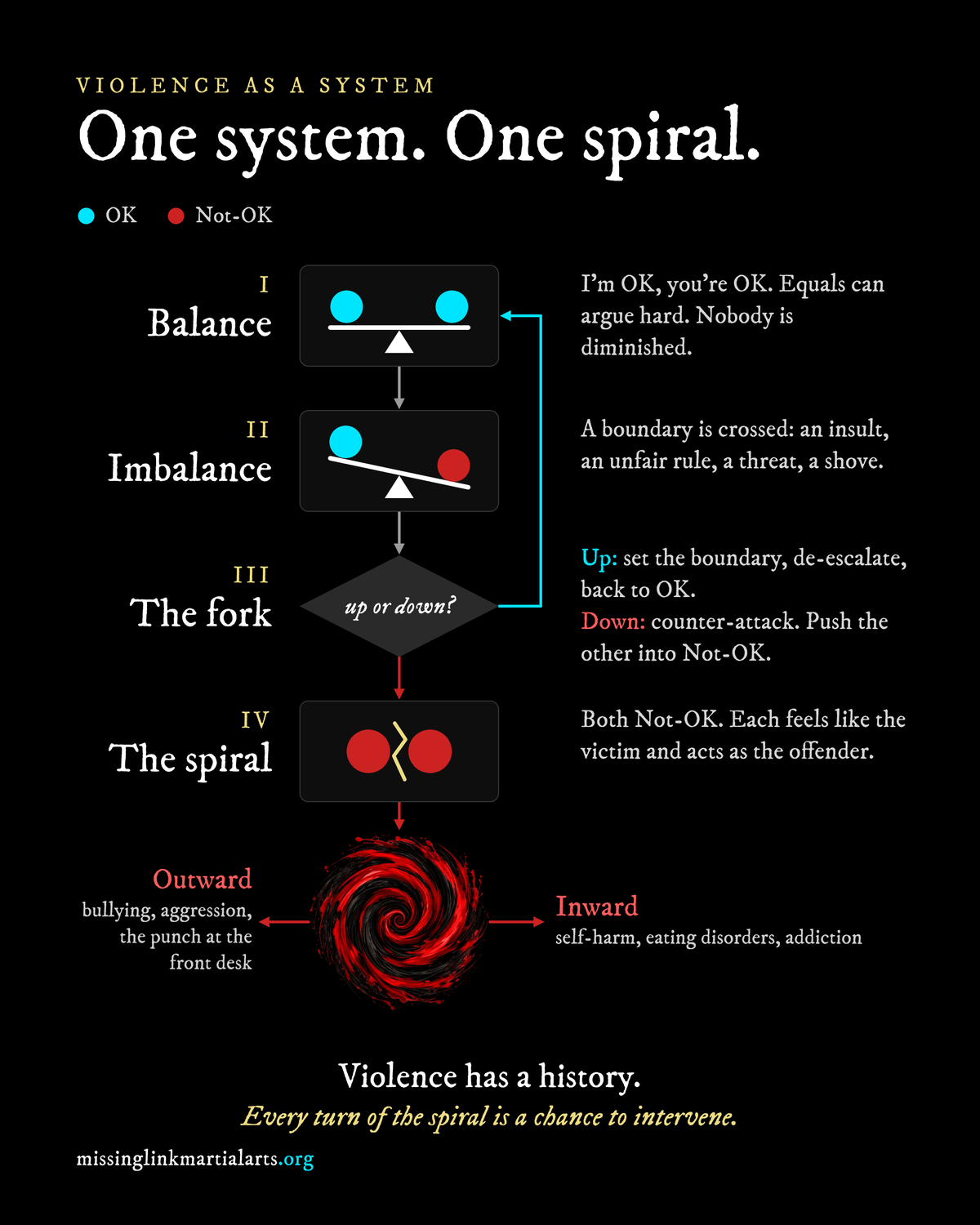
Unresolved Not-OK is pressure, and pressure goes somewhere. If it can't go up, it goes outward: bullying, aggression, the punch at the front desk. Or it goes inward, against the person's own body and mind: self-harm, eating disorders, addiction. Alcohol and drugs lend an OK-feeling for a few hours, while the imbalance underneath stays untouched.
Both directions feed on the same root: people cut off from their own bodies and feelings. It's the de-bodification that modern life produces, and that our training works against.
When the dust settles there are usually two victims, whoever started it. Escalation hurts the offender too.
This is the heart of the matter. Violence has a history. It never comes out of the blue. What looks like a sudden eruption is a spiral that has been turning for a long time, and every turn of it was a chance to intervene.
Is violence always bad?
No. And being honest about that is a precondition of prevention.
A violence-free society doesn't exist. Interests collide; competition and conflict are part of life. Force, in the right place, is necessary and right: defending your own boundaries when nothing else works, restraining someone who would harm themselves, fining the dangerous driver, arresting the offender, testing strength and skill in consensual competition.
The taboo formula "violence is never the solution" only produces hypocrisy. The adult who forbids a child all force, and five minutes later forces homework and a tidy room, is teaching the double message, not peace. A martial arts workshop under the banner "violence is not the solution" is about as credible as soldiers marching to war under "fighting is not an option".
But honesty cuts both ways. A carer restraining a person with dementia uses violence. So does a police officer making an arrest. Calling it something else doesn't make it gentler, only less examined. The question is never "Is it violence?" The questions are:
Is it necessary? Is it appropriate and limited? Is someone accountable for it?
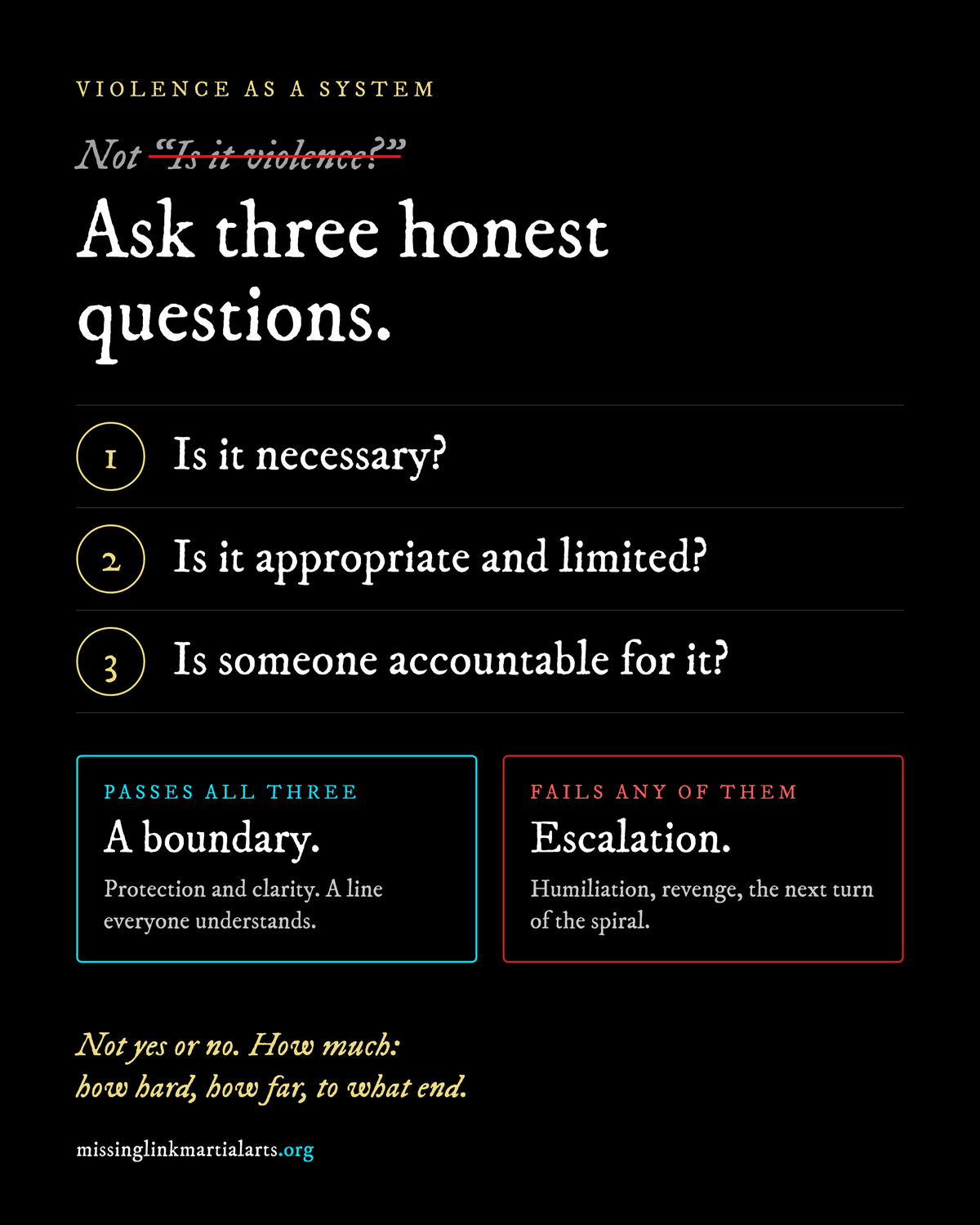
Violence, in other words, is not a yes-or-no question. It's a how-much one: how hard, how far, to what end.
This applies most of all to punishment. Every sanction is experienced as violence. That is precisely what makes it work as a boundary, and what makes it dangerous. A punishment that merely creates a loser feeds the next spiral. A sanction that deserves the name is clearly felt, fair and transparent, and it leaves a path to do better: coaching on the way, and recognition when the person takes it.
Accountability must point forward. Revenge points back.
What prevention actually is
If violence is a system, prevention is neither "avoid conflict at all costs" nor "keep the bad people away from the good ones". Every society contains people who can't or won't empathise. It contains far more ordinary people who turn aggressive when life pushes them into a corner. So prevention works on two levels at once.
Capable people. This is the individual level, and it is what we train. We help people reconnect body and mind, and recognise their own aggression before it acts. We teach them to respect other people's boundaries and to know, communicate and defend their own. To de-escalate where possible, and to fight, decisively and accountably, when it's unavoidable. Resilient enough not to be made a victim by every friction. Empathetic enough not to make victims.
Rooms that work. None of us redesigns society alone. But each of us runs at least one room inside it: a family, a classroom, a dojo, a shift, a team. Rooms that prevent violence share three rules.
- Reward problem-solving, not ruthlessness. A community that puts winning, dominating and humiliating on a pedestal teaches everyone that the way up leads over someone else. Competition stays healthy in its place: as one part of life, not its measure.
- Human connection, not paper walls. Procedures can document safety. Only relationships create it. When fear of liability stops a teacher comforting a crying child, or closes the quiet conversation in which an abused child finally speaks, protection has eaten its own purpose. Scotland's Violence Reduction Unit, born in Glasgow, shows the alternative. Its Navigators work in hospital emergency departments and meet people at the "reachable moment", with a person rather than a form, and break spirals that punishment alone never reached.
- Accountability that points forward. A healthy community knows three kinds of mistakes:
- Small mistakes: an accident, a clumsy word, a bad day. Forgive and move on.
- Serious mistakes: the boundary is enforced, clearly and appropriately. When responsibility is taken and behaviour changes, the mistake is forgiven (not necessarily forgotten) and the relationship restarts.
- Unforgivable mistakes: in ordinary life, extraordinarily rare. Treat them as common and you poison every relationship. Treat them as possible and justice stays honest.
Built, not fallen
Violence is a system, not an event. It is physical, psychological and structural. It is measured by the hurt on the receiving end, not by the fist. It grows in spirals that start long before the first blow, and it discharges outward against others or inward against the self. It can't be abolished. But it can be understood, limited and answered.
That is the work: people who know their own strength and their own boundaries, inside communities that reward problem-solving and hold everyone accountable. Including the powerful. Including the punisher.
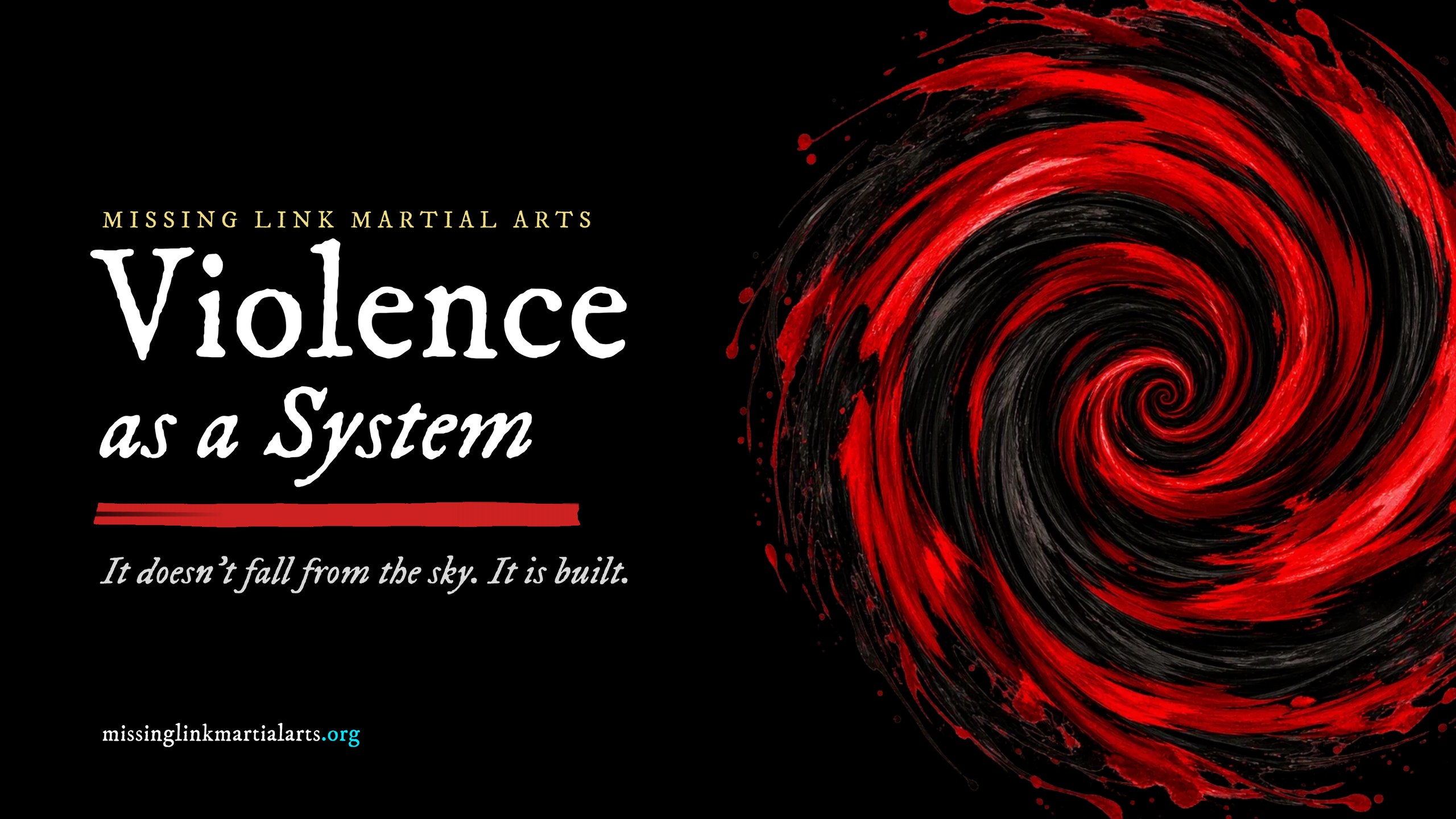
Violence doesn't fall from the sky. It is built. And what is built can be built differently.
Further reading
The definition and the spiral were first set out in our book Missing Links of Martial Arts (Miketta, Heinz & Wagener, 2018). Structural violence comes from Johan Galtung's "Violence, Peace, and Peace Research" (1969), the escalation staircase from Friedrich Glasl's Confronting Conflict (1999), and sanctions that point forward from John Braithwaite's Crime, Shame and Reintegration (1989).
If anything in this post touches your own life: Samaritans listen any time, day or night, free on 116 123. Anyone affected by sexual violence can call the Rape Crisis Scotland helpline free on 08088 01 03 02, every day from 5pm to midnight.
Recent Posts
Making Karate Your Own — From Imitation to Personal Expression
What must we do as learners to make our Karate truly our own? by Sandro Sandten.
Combat Has Structure — Chaos Is Only the Surface
Combat often looks chaotic. Especially in unarmed fighting, many things happen at once: movement, striking, pressure, balance, clinch, interruption, disengagement, re-entry.