

When Training Feels Stuck
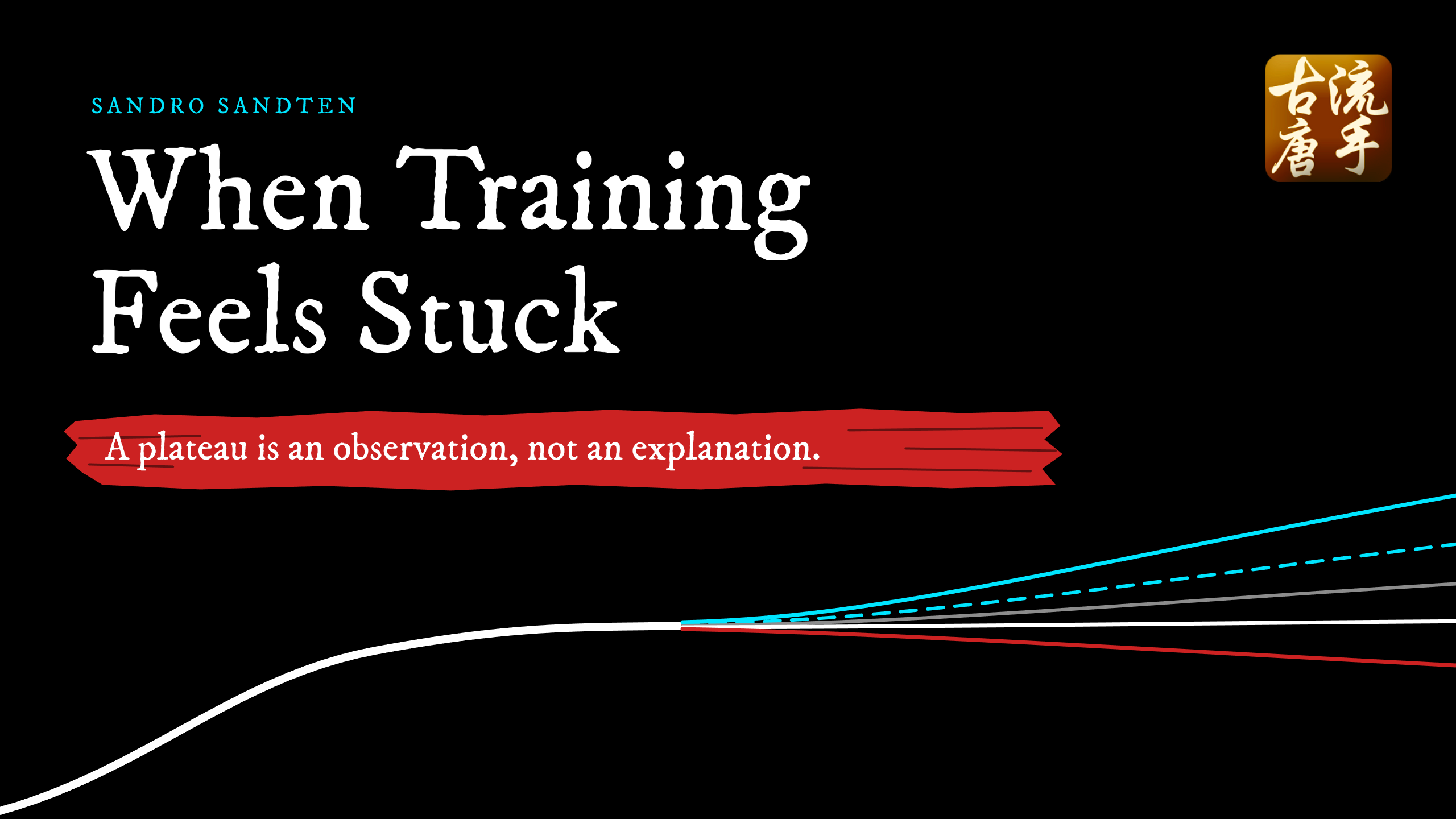
Why a plateau is an observation, not an explanation. By Sandro Sandten.
You know the exercise. You know the sequence. You can perform the movements with reasonable control, and familiar situations feel easier to manage than they once did.
Yet after months of practice, you struggle to identify what has actually changed. Training feels much the same, and progress becomes difficult to recognise.
How do we know we are learning when our performance seems to have stopped improving?
A plateau is an observation, not an explanation
A plateau describes our perception of progress: improvement seems to have slowed or stopped. It does not explain why.
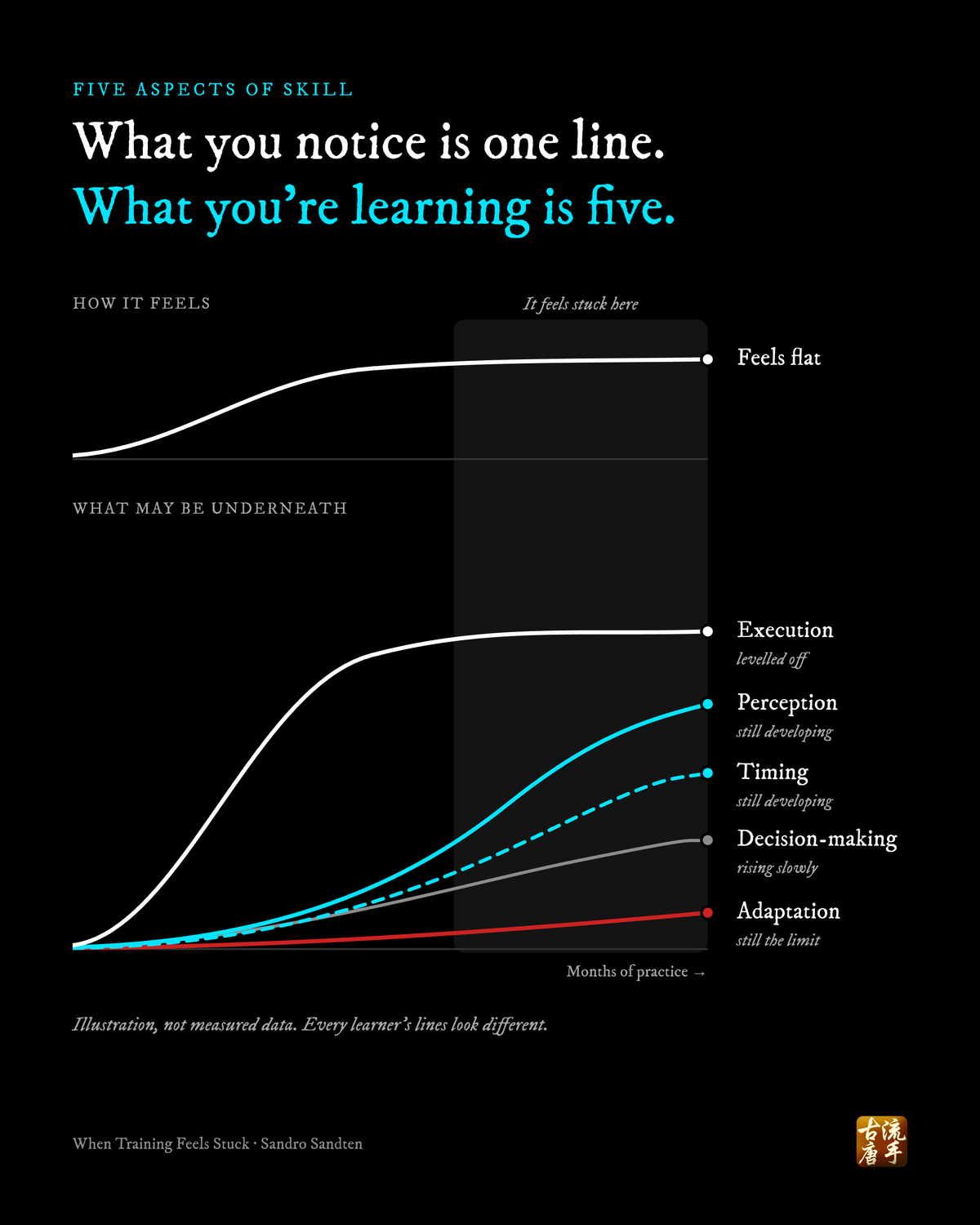
In partner-based martial arts such as Karate, we learn to manage distance, respond to pressure, maintain balance, read another person's intentions and adapt to their actions. These abilities are connected, but they do not necessarily develop at the same rate.
A practitioner may become more coordinated without becoming better at deciding when to act. They may respond reliably to a familiar attack but struggle when their partner changes the distance or timing.
A plateau tells us that progress is difficult to recognise. It does not tell us whether learning has stopped.
To understand what is happening, we need to look beyond overall performance and examine the skills involved.
What are we actually learning?
Imagine a practitioner learning to respond to an incoming attack.
Initially, they struggle to coordinate the movement. Their feet are poorly positioned, their balance is unstable, and their hands arrive too late. With practice, the response becomes more controlled and reliable.
But coordination is only one part of the skill. The practitioner may perform the exercise comfortably under familiar conditions yet struggle when the distance or timing changes.
It helps to distinguish between several connected aspects of skill:
- Execution: Can I perform the movement with appropriate coordination and control?
- Perception: Can I pick up relevant information through sight, distance and contact?
- Decision-making: Can I choose an appropriate response?
- Timing: Can I act at the right moment?
- Adaptation: Can I adjust when my partner changes the situation?
These aspects influence one another, but improvement in one does not automatically mean improvement in all the others. A technically clean movement does not guarantee good timing or sound adaptation.
The useful question is which part of our ability is changing—and what still limits it.
Learning to recognise possibilities
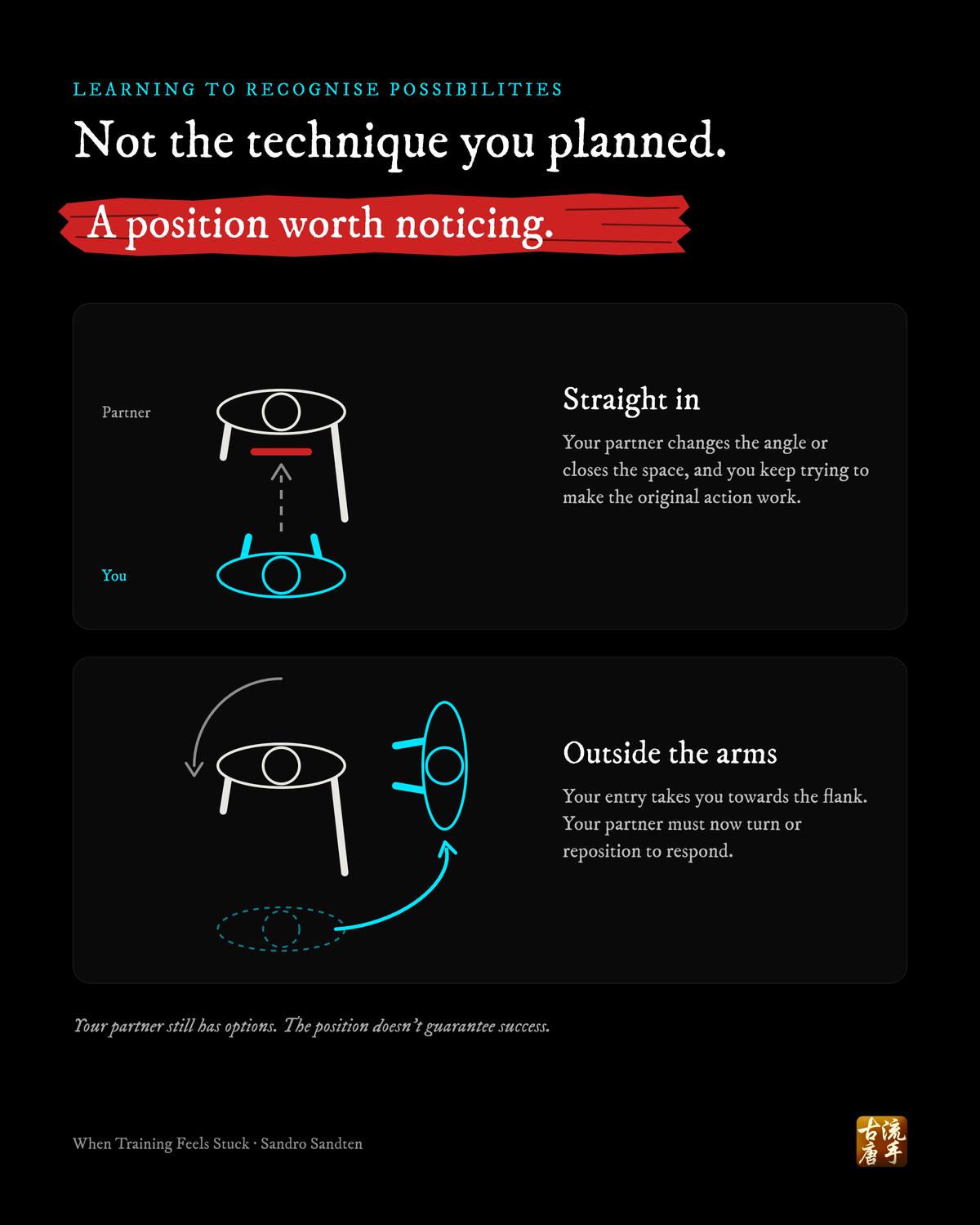
Consider a controlled partner exercise in which you are trying to enter past an incoming attack.
Initially, your attention is focused on performing the intended technique. When your partner changes the angle or closes the available space, you may continue trying to make the original action work.
With experience, your attention can shift. You begin to notice how your movement changes the relationship between you and your partner.
Perhaps your entry does not lead to the intended technique, but takes you outside your partner's arms and towards their flank. This position gives you different tactical options from remaining directly in front of them. Your partner must now turn or reposition to respond.
The important change is not simply that you have reached a different position, but that you understand its tactical advantages and adjust your actions accordingly.
Your partner still has options, and the position does not guarantee success. The developing skill lies in understanding how movement changes the relationship between you, what opportunities that creates and how to act on them.
You may spot an opportunity that you previously overlooked, or adjust sooner because you read the situation more clearly. These changes are not necessarily captured by counting how often a particular technique succeeds.
Heero Miketta explores a related distinction in Practical Skill Beyond the Tickbox, examining why completing a technical requirement is not the same as developing practical skill.
But recognising possibilities in one exercise is only part of the process. Can we use what we have learned when the situation changes? Jorge F. Garibaldi examines this relationship between practice and application in Karate.
Recognising progress over time
As we learn, our understanding of a task changes. A beginner may focus on remembering a sequence or coordinating a movement. With experience, they begin to notice details they previously overlooked: losses of balance, changes in timing or opportunities to act.
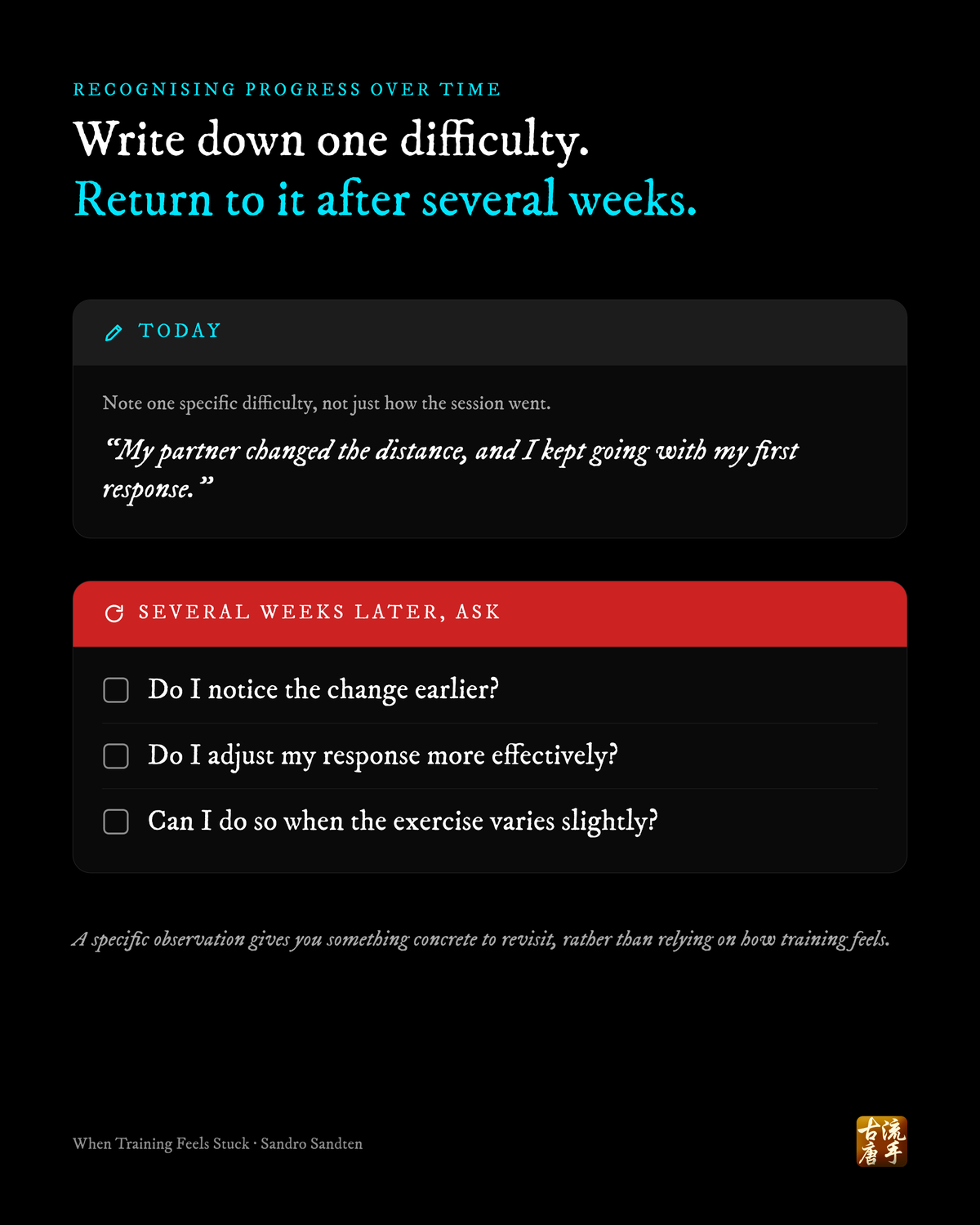
A training journal can help make these changes visible. Rather than recording only how a session went, note one specific difficulty. Perhaps you struggled to read a change in distance or continued with an initial response after the situation had changed.
Return to that observation after several weeks and ask:
- Do I notice the change earlier?
- Do I adjust my response more effectively?
- Can I do so when the exercise varies slightly?
The comparison will not be perfect. Your partner and the circumstances may differ. But a specific observation gives you something concrete to revisit, rather than relying solely on your immediate impression of how training feels.
In The Karate Buddy – Learning, Even When You Can't Make It to the Dojo, I discuss keeping a training journal as a way to reflect on progress.
When progress really stalls
Sometimes, progress really does stall. Looking at our training differently cannot compensate for an exercise that no longer challenges the skill we want to develop.
Repeating a familiar movement can help consolidate coordination and control. But if the task always presents the same distance, timing and response, it may do little to improve our ability to adapt when those conditions change.
Fatigue, unsuitable challenges or a lack of useful feedback can also limit development. Before concluding that we have reached our limits, we need to examine both our performance and the conditions in which we practise.
What is the exercise designed to develop? Does it challenge the relevant skill? Are we receiving useful information about what works and what does not?
Sometimes the answer is to continue practising a movement until it becomes more reliable. At other times, we need to vary the task, change the constraints or introduce a different challenge.
The point is not to make training more complicated or to change exercises simply for the sake of variety. It is to ensure that our practice addresses the skill we want to develop.
What does this mean for instructors?
The same challenge arises when assessing someone else's progress.
A student may perform an exercise consistently, but consistency alone tells us only so much. It does not necessarily show how their understanding has changed or whether they can use the skill when circumstances change.
Instructors can ask three questions.
What has changed in the student's performance?
Look beyond the outcome. Has their coordination improved? Do they pick up relevant information earlier or adapt more effectively?
What still limits their progress?
The difficulty may lie in execution, perception, timing, decision-making or adaptation. Identifying the limitation helps clarify what deserves attention.
Does the exercise address what we want to teach?
A student may need to consolidate a movement under familiar conditions. Alternatively, a controlled variation may reveal how they respond when circumstances change.
The appropriate choice depends on the learner, the skill and the demands of the task. The instructor's job is to understand what the student needs, rather than simply increasing the difficulty or adding more exercises.
Our role is not simply to make exercises look successful. It is to help students develop skills they can actually use.
A different perspective on progress
When training feels stuck, look beyond whether a technique works. Ask yourself:
What do I notice, understand or respond to now that I struggled with—or did not even recognise—a few months ago?
The answer may reveal progress that a successful technique or a familiar exercise cannot show. It may also reveal that something in your training needs to change.
Both are useful findings. One helps you understand how you have improved; the other gives you a direction for further development.
A plateau is an observation, not an explanation.
About the Author
Sandro Sandten is the Chief Instructor for Missing Link Martial Arts in Germany. He teaches partner-oriented Karate in Meerbusch, near Düsseldorf, with a focus on practical skill, sustainable training and the principles underlying movement and technique.
Find out more about his training at Karate Meerbusch.
Recent Posts
Violence as a System
Heero Miketta on why violence never comes out of the blue, and where prevention really starts.
Making Karate Your Own — From Imitation to Personal Expression
What must we do as learners to make our Karate truly our own? by Sandro Sandten.